
Nebraska DMV Permit Practice Test 11
- Questions25
- Correct to pass20
- Passing score80%
- Minimum age15 years
-
1. From what age may a Nebraska permit, license or State ID card holder record an organ and tissue donation decision at the DMV?
Show answer
Answer D: 16
Nebraska law lets holders aged 16 and over declare organ and tissue donation, although a parent or guardian may amend the decision of a donor under 18.
-
2. You are slowing to turn right at an intersection and a bicyclist is riding beside your right side in a bike lane. What should you do?
Show answer
Answer D: Let the bicyclist go through the intersection before you begin the turn
Turning across the path of a bicyclist who is going straight causes the classic right-hook crash. The rider continuing straight has the right-of-way over your turn.
-
3. What should you expect while driving through a parking lot?
Show answer
Answer D: Pedestrians and vehicles moving from any direction, so drive slowly
Parking lots mix walking people, reversing vehicles and poor sight lines, so low speed and constant scanning are the only reliable protection.
-
4. The driver ahead of you is straddling the lane line and is not signaling. How should you respond?
Show answer
Answer B: Stay back until you can see which lane that driver will take
A vehicle astride the line could move either way, so the only safe place is behind it where both possibilities are still covered.
-
5. You are hosting a party and a guest who has been drinking wants to drive home. What should you do?
Show answer
Answer D: Stop serving and arrange a ride or a bed
Only time removes alcohol, so a host who wants to prevent a crash has to remove the driving, not try to speed up sobering that cannot be sped up.
-
6. You arrive at a four-way stop after two other vehicles have already stopped there. When is it your turn?
Show answer
Answer A: After both of the earlier vehicles have gone
Vehicles clear a four-way stop in the order they arrived, so the third driver to stop is the third to go.
-
7. Why does a dirty windshield matter much more at night than during the day?
Show answer
Answer C: Dust and streaks scatter oncoming light and increase glare
Film and streaks on the glass spread every oncoming headlight into a star of glare, so clean the inside as well as the outside before a night trip.
-
8. A tow truck with flashing amber lights is loading a car on the shoulder ahead. How should you treat it?
Show answer
Answer B: Give it the same room as an emergency vehicle
Tow operators, utility crews and highway workers face the same danger from passing traffic, so move over or slow down for their flashing amber lights too.
-
9. Does using a hands free device remove the risk of distraction?
Show answer
Answer A: No, the conversation still takes attention away from driving
Hands free equipment removes the manual part of the distraction but not the mental part, and a driver deep in conversation can look straight at a hazard without registering it.
-
10. School warning signs use which background and legend colors?
Show answer
Answer A: A black legend and border on a fluorescent yellow-green background
School warning signs carry a black legend and border on a fluorescent yellow-green background, a shade chosen so they stand out from ordinary yellow warning signs.
-
11. In a normal signal cycle, what comes after a steady red indication?
Show answer
Answer A: A green indication that starts the next movement
Yellow is a warning that a movement is ending, so it never precedes a green; a red is followed by a green or a green arrow.
-
12. The steering suddenly becomes very heavy while you are driving. What has happened and what should you do?
Show answer
Answer C: The power steering has failed, so steer with more effort and pull over
Loss of power assistance leaves the steering usable but very heavy. Keep both hands on the wheel, slow gradually and pull off the road to check it.
-
13. Which sequence describes a well-made turn?
Show answer
Answer A: Signal, move into the correct lane, slow down, check, then turn
Tell others first, take your position, lose the speed before the corner, take a final look, and only then steer through the turn.
-
14. The light ahead is green but traffic beyond the intersection is backed up. What should you do?
Show answer
Answer B: Wait behind the intersection until there is room to clear it completely
You may not enter an intersection unless you can get completely through it, because stopping inside blocks cross traffic when the signal changes.
-
15. Your vehicle has stalled on railroad tracks and no train is in sight. After getting everyone away, whom should you call first?
Show answer
Answer B: The railroad emergency number posted on the blue sign at the crossing, giving the crossing number
Every public crossing has a blue emergency notification sign with a phone number and a crossing identification number. That call lets the railroad stop or slow trains before they reach you.
-
16. You are waiting to turn left across two oncoming lanes when a driver in the near lane stops and waves you through. What should you do?
Show answer
Answer D: Turn only after checking the far lane yourself
The waving driver cannot give away the right of way of the traffic in the second lane, which may not be stopping at all.
-
17. You are about to slow down sharply for a turn. Which check comes first?
Show answer
Answer A: A look in the mirror to see how close the traffic behind you is
Any hard slowing needs a mirror check first, because the driver behind is the one who has to react to it.
-
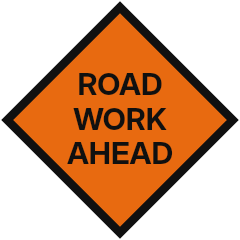
18. Beyond this sign, cones and temporary signs lead traffic along a path that does not agree with the lines painted on the pavement. Which one must the driver follow?
Show answer
Answer C: The temporary arrangement, because it replaces the permanent layout while the work lasts
Temporary traffic control set up for the work takes precedence over the permanent signs and markings, which no longer describe how the road is being used.
-
19. Two solid white lines separate your lane from the lane beside it. What do they mean?
Show answer
Answer B: Crossing from one lane to the other is prohibited
A solid double white line marks a boundary that road users may not cross, such as the entrance to a preferential lane.
-
20. How do strong emotions affect driving?
Show answer
Answer B: They narrow your attention and make risky decisions more likely
Anger, worry and excitement all take attention away from the driving task and push drivers toward decisions they would not normally make.
-
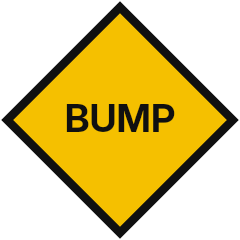
21. How should a driver respond to this sign?
Show answer
Answer C: Slow down before reaching the rough spot and cross it at a steady, low speed
Losing speed before a sharp rise in the pavement keeps the vehicle settled, while braking or accelerating on top of it unsettles the suspension and costs grip.
-
22. You are entering a marked school zone during the posted hours. What should you do?
Show answer
Answer A: Slow to the school zone limit and watch for children
The school zone limit applies throughout the posted hours, whether or not you can see any children at that moment.
-
23. Is it acceptable to drive far below the flow of traffic on an open highway?
Show answer
Answer B: No, driving too slowly can obstruct traffic and create a hazard
Traffic that is much slower than the surrounding flow forces other drivers into sudden braking and unnecessary passing maneuvers, and impeding traffic is itself a violation.
-
24. As a general rule, how far should you travel along a center two-way left-turn lane before you turn?
Show answer
Answer C: Only a short distance, just enough to slow down and wait for a gap
The center lane is for making or preparing a left turn, so you enter it only shortly before the turn and never travel along it as a through lane; several states set a specific limit such as 200 or 300 feet.
-
25. What does a NARROW BRIDGE warning sign tell a driver?
Show answer
Answer A: The bridge is tighter than the road leading up to it
A narrow bridge still carries both directions, but with much less clearance than the approaches, so drivers should slow and hold their lane position carefully.