
Nebraska DMV Permit Practice Test 29
- Questions25
- Correct to pass20
- Passing score80%
- Minimum age15 years
-
1. You are approaching the entry of a modern roundabout. Who must you yield to?
Show answer
Answer C: Traffic already circulating in the roundabout, which approaches from your left
Traffic in a United States roundabout circulates counterclockwise, so drivers entering must look left and yield to vehicles already in the circulating roadway.
-
2. A steady green arrow pointing left is displayed for your turning lane. What does it tell you?
Show answer
Answer D: The turn is protected because conflicting traffic is being held
A steady green arrow gives a protected movement in the direction shown, although you still yield to pedestrians and to any vehicle already inside the intersection.
-
3. At the scene of a crash you were part of, what are you required to do besides stopping?
Show answer
Answer B: Give your name, your address and vehicle details, and help anyone who is hurt
Every state requires drivers involved in a crash to identify themselves and to render reasonable aid to anyone injured.
-
4. How does the blood alcohol standard for a driver operating a commercial vehicle compare with the one for a car driver?
Show answer
Answer D: It is lower, set at 0.04
Commercial drivers are held to a stricter standard of 0.04 because of the size of their vehicles and the risk they carry.
-
5. You find that your shoulder belt has some slack in it. Why does that matter?
Show answer
Answer D: You travel further before the belt restrains you, so injuries are worse
Slack lets your body build up speed before the belt takes hold, which increases the forces on you and the risk of hitting the interior.
-
6. You have signaled and pulled up level with the car in front of an empty curb space. What comes next?
Show answer
Answer A: Reverse slowly while turning the wheel toward the curb
From alongside the forward car you back in on a turn toward the curb, then straighten and swing the front in as the rear reaches the space.
-
7. You are stopped at a stop sign waiting to turn onto a highway where traffic moves at 55 mph. How should you choose your gap?
Show answer
Answer A: Wait for a much larger gap than the one you would accept on a city street
Fast traffic covers ground while you are still accelerating, so the gap that feels adequate at 25 mph is dangerously short at highway speed.
-
8. Once you are moving, which way of using a navigation device costs you the least attention?
Show answer
Answer B: Listening to the spoken directions
Voice guidance lets you keep your eyes on the road, while anything that needs the screen takes glances that add up over a trip.
-
9. How can you check that you are keeping a safe following distance?
Show answer
Answer A: Count at least three seconds between the vehicle ahead passing a fixed object and your reaching it
Pick a fixed roadside object, start counting when the vehicle ahead passes it and make sure at least three seconds elapse before you reach it, adding more time in poor conditions.
-
10. A police officer in the intersection raises a hand toward you although your signal is green. What should you do?
Show answer
Answer B: Stop and wait for the officer to wave you on
An officer directing traffic overrides signals and signs, and drivers must follow the officer even when the light says otherwise.
-
11. You are entering an angle parking space on your right. What should you do?
Show answer
Answer C: Stay a little left of the space, then turn in between the lines
Keeping a little left of the space gives the front wheels the room to turn in cleanly and leaves your car centered between the lines.
-
12. Federal law lets a state open its high-occupancy vehicle lanes to certain vehicles carrying only one person. Which of these is covered by that allowance?
Show answer
Answer B: Motorcycles
Federal law lets states allow motorcycles into high-occupancy vehicle lanes regardless of the number of occupants, because keeping riders in the flow is safer than the alternative.
-
13. Cannabis is legal for adults in some states. What does that mean for driving?
Show answer
Answer C: Driving while impaired by it is still an offense
Legal possession has nothing to do with driving law, and every state treats driving while impaired by cannabis as an offense.
-
14. A steady green downward arrow is displayed above the lane you are in. What does it tell you?
Show answer
Answer A: You may drive in that lane
A green downward arrow means the lane beneath it is open for travel in your direction.
-
15. What is the correct technique for backing a vehicle straight?
Show answer
Answer B: Check behind the vehicle before getting in, then turn and look through the rear window while backing slowly
Mirrors and cameras leave gaps close to the vehicle, so walk behind it first, then turn in your seat for a direct view and keep the speed low enough to stop instantly.
-
16. You are approaching a multilane roundabout. When should you choose your lane?
Show answer
Answer C: Before you enter, using the lane-choice sign on the approach
You select your lane on the approach the way you would at any multilane intersection, then stay in that lane all the way around, because changing lanes inside a roundabout creates side-impact conflicts.
-
17. An oncoming vehicle at night has its high beams on and you are being dazzled. Where should you look?
Show answer
Answer A: Toward the right edge of your lane
Looking toward the right edge line keeps you on course while sparing your eyes the worst of the glare. Slow down and do not retaliate with your own high beams.
-
18. Some crosswalks are marked with two transverse lines and others with a row of wide bars laid along the direction of travel. Why is the second pattern used?
Show answer
Answer B: It is far easier for an approaching driver to see
Longitudinal bar patterns are used where extra visibility is wanted, such as an uncontrolled crossing or one near a school, because they show up much better from a car.
-
19. The motorcyclist ahead of you keeps moving from one side of the lane to the other. What should you understand?
Show answer
Answer B: The rider is avoiding surface hazards and staying where drivers can see the bike
Riders shift their lane position to avoid debris, grease strips and potholes and to be seen. That movement is normal and never an invitation to share the lane.
-
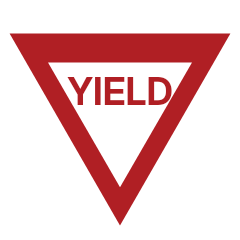
20. A driver reaches this sign and the intersecting roadway is completely clear. What is required?
Show answer
Answer D: Slowing to a speed that allows stopping, then going on without stopping if the way stays clear
This control asks the driver to slow down and be ready to stop, and a full stop becomes necessary only when traffic or pedestrians would otherwise be interfered with.
-
21. What must you do before changing lanes, in addition to signaling and checking your mirrors?
Show answer
Answer D: Glance over your shoulder to check the blind spot the mirrors do not cover
Mirrors leave an area beside and behind the vehicle that they cannot show, so a quick head check is needed before the vehicle moves sideways.
-
22. You have stopped on the shoulder of a busy freeway with a flat tire that you cannot change safely. Where should you and your passengers wait?
Show answer
Answer A: Well away from the traffic side, behind a barrier or up the bank if there is one
People struck on the shoulder are a common cause of roadside deaths, so wait away from the traffic side and behind any barrier.
-
23. A hands free phone conversation is which kind of distraction?
Show answer
Answer C: Cognitive, because your mind leaves the road
Hands free equipment removes the manual and visual parts of a call but not the mental load, and it is the mental load that makes a driver miss hazards.
-
24. The rear of your vehicle begins to slide sideways on a slippery surface. What is the correct correction?
Show answer
Answer C: Ease off the accelerator and steer in the direction you want the front of the vehicle to go
Looking and steering toward your intended path lines the front wheels up with the direction of travel, while sudden braking or a sharp opposite input usually makes the slide worse.
-
25. You are passing a tractor-trailer on a wet freeway and its wheels throw heavy spray. What is the best technique?
Show answer
Answer B: Increase your wipers and pass steadily without hesitating
Spray blinds you for as long as you stay beside the truck, so prepare the wipers first and then spend as little time in the spray as possible.