
Nebraska DMV Permit Practice Test 36
- Questions25
- Correct to pass20
- Passing score80%
- Minimum age15 years
-
1. A person using a wheelchair is waiting to cross at a corner ahead. How should you treat that person?
Show answer
Answer B: As a pedestrian with the right of way at the crossing
A wheelchair or a mobility scooter user has the rights of a pedestrian, so yield the whole crossing and wait until the crossing is finished.
-
2. How does higher speed affect the outcome of a crash?
Show answer
Answer A: It leaves less time to react and greatly increases the force of impact
Speed shortens the time available to avoid a hazard and raises the energy released in an impact, so both the likelihood and the severity of a crash increase.
-
3. A single solid white line separates two lanes running in the same direction. What is it telling drivers?
Show answer
Answer A: Changing lanes there is discouraged
A solid white lane line discourages lane changing, typically where merging or weaving would create a hazard.
-
4. For an alert driver, about how long is the reaction time once a hazard has been recognized?
Show answer
Answer A: About three quarters of a second
Reaction alone takes roughly three quarters of a second for an alert driver, and perception takes about as long again, so a second and a half of travel is added before the brakes bite.
-
5. A sign showing a figure with an outstretched thumb inside a red circle with a slash means that
Show answer
Answer B: soliciting a ride is prohibited there
The no hitchhiking sign bars standing beside the road to solicit a ride, and it is common along freeway ramps and shoulders.
-
6. A rectangular marker with alternating black and retroreflective yellow stripes set at a slant is used to
Show answer
Answer C: mark an obstruction, with the stripes sloping down toward the side on which traffic should pass
This striped panel is an object marker, and the direction in which the stripes slope shows the driver which side of the obstruction to pass on.
-
7. A pedestrian near the curb is staring at a phone and not looking at traffic. What should you do?
Show answer
Answer A: Slow down and be ready to stop, because the pedestrian may step out without looking
Distracted pedestrians step into the street without checking. Assume they have not seen you and give yourself time and space to stop.
-
8. Traffic in your lane is backed up and the paved shoulder looks clear. May you drive along it to get past?
Show answer
Answer C: No, the shoulder is not a travel lane
Passing must be done within the roadway; driving on the shoulder to get around traffic is prohibited and surprises anyone entering from the right.
-
9. The route marker used for an Interstate highway is a shield with
Show answer
Answer A: white numerals on a blue field under a red band carrying the word INTERSTATE
The Interstate route marker is a cutout shield with a white border, the word INTERSTATE in white on red across the top and the route number in white on blue.
-
10. Two drivers each have three drinks, one over three hours and one in half an hour. What is the difference?
Show answer
Answer C: The fast drinker reaches a higher peak level
The liver removes alcohol at a steady rate, so drinking faster than the body can clear it pushes the blood alcohol level much higher.
-
11. You and a driver coming from the opposite direction reach a four-way stop at the same time and you are both going straight ahead. What happens next?
Show answer
Answer D: Both of you may move off together, because your paths do not cross each other
Opposing vehicles that are both going straight do not cross paths, so they can move off together once the intersection is clear.
-
12. The driver of a slow farm vehicle moves partly onto the shoulder and waves you past. Who is responsible for the pass?
Show answer
Answer A: You are, so pass only if you can see that the road is clear
A courtesy wave is not a traffic control, and the driver who changes lanes is the one answerable for the maneuver.
-
13. You are approaching a yield sign on a ramp that joins a busy street. What does the sign require?
Show answer
Answer A: Slow down, be ready to stop, and let the other traffic go first
A yield sign means you must slow, be prepared to stop and give way to traffic on the road you are entering; a full stop is required only when traffic makes it necessary.
-
14. You are turning left at an intersection and an oncoming bicyclist is approaching in the bike lane. What must you do?
Show answer
Answer B: Yield and complete the turn only after the bicyclist has passed
A bicycle in the roadway has the same right of way as a vehicle, so a left-turning driver must yield to an oncoming rider just as to an oncoming car.
-
15. At what point must a Nebraska driver dim the high beams when following another vehicle?
Show answer
Answer B: Within 200 feet
Nebraska requires headlights to be dimmed when following within two hundred feet of another vehicle, and also when meeting oncoming vehicles.
-
16. A 17-year-old in Nebraska wants a Class O license. What does the state require?
Show answer
Answer A: A Provisional Operator's Permit held 12 months with fewer than three points in that time
Applicants under 18 must have held a Provisional Operator's Permit for at least twelve months without accumulating three or more points during that period, and the tests are then waived.
-
17. After a crash your door will not open and you need to get out of the car. What should you try?
Show answer
Answer B: Try another door of the vehicle, or a window that will still open properly
A jammed door is common after an impact, and the simplest escape is a different door or a window rather than forcing the damaged one.
-
18. What is the driver expected to do after passing this sign?
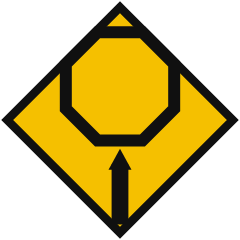
Show answer
Answer A: Begin slowing so that a complete stop can be made at the intersection ahead
It is used where the control at the intersection stays hidden until late, so braking should begin here rather than at the stop line.
-
19. You are entering a freeway using an on-ramp with an acceleration lane. What is the correct technique?
Show answer
Answer C: Use the acceleration lane to reach the speed of traffic, then merge into a gap while yielding to traffic already on the freeway
The acceleration lane exists so you can match the speed of freeway traffic before merging, and drivers already on the freeway have the right-of-way.
-
20. Your vehicle stalls on a railroad crossing and will not restart. What should you do first?
Show answer
Answer A: Get everyone out and away from the tracks immediately
Everyone must leave the vehicle and move well clear of the tracks at once, walking toward the train at an angle so that debris from an impact travels away from you.
-
21. Which sign shape is reserved for one message only, the requirement to stop?
Show answer
Answer A: The octagon
The octagon is used for the stop sign and for no other message, so the outline alone identifies the requirement even when the legend is hard to read.
-
22. A sign reads MINIMUM SPEED 40. What does it require of a driver?
Show answer
Answer C: Not to drive below that speed when conditions allow
A minimum speed limit keeps unnecessarily slow vehicles from obstructing traffic, but it never overrides the duty to slow down for weather or congestion.
-
23. Why should the shoulder belt never be worn under the arm or behind the back?
Show answer
Answer C: In a crash it could not hold your upper body and could cause severe injury
The shoulder belt restrains your chest and head. Placed under the arm it concentrates crash force on the ribs and organs; behind the back it does nothing at all.
-
24. Two solid white lines are painted between your lane and the lane beside it. What do they mean?
Show answer
Answer D: Crossing from one lane to the other is prohibited
Double solid white lines separate lanes of traffic going the same way and may not be crossed.
-
25. How is the yield sign shaped and colored?
Show answer
Answer C: A downward-pointing triangle with a wide red border and a red legend on white
The yield sign is a downward-pointing equilateral triangle with a wide red border and the legend in red on a white background, an outline used for no other message.