
Nebraska DMV Motorcycle Practice Test 53
- Questions25
- Correct to pass20
- Passing score80%
- Minimum age17 years
-
1. A squirrel darts into your path a short distance ahead. What is normally the safest response?
Show answer
Answer C: Hold your line, brake as much as is safe, and accept hitting a small animal
Swerving without space, or crashing while braking, hurts the rider far more than a small animal does, so stay in your lane and slow as much as traction allows.
-
2. Where is reflective material most effective at attracting a driver's attention at night?
Show answer
Answer A: On the arms, legs and helmet, where the movement draws the eye
Reflective patches that move as the rider rides are noticed sooner than static ones, and a helmet sits high where drivers are already looking.
-
3. What is the purpose of the padding built into the shoulders, elbows and knees of riding gear?
Show answer
Answer C: It absorbs impact energy at the joints most likely to strike first
Armor at the joints spreads and absorbs the force of an impact in the places that usually hit the ground first in a fall.
-
4. What is the correct way to think about protective gear?
Show answer
Answer D: It reduces injury in a crash but does nothing to prevent one
Gear is the last line of defense. Avoiding the crash depends on skill, speed choice, space and visibility, and gear only limits the damage when those fail.
-
5. After a Nebraska court-ordered revocation for a serious traffic violation, how long must proof of financial responsibility be filed?
Show answer
Answer B: Three years from the ending date of the original revocation
A court-ordered revocation carries a three-year proof of financial responsibility requirement, running from the ending date of the original revocation.
-
6. You reach a stretch of road covered by moving flood water of unknown depth. What is the correct decision?
Show answer
Answer D: Turn around and take another route
About a foot of moving water is enough to carry away most cars, and the roadbed under the water may already be washed out, so the only safe choice is to turn around.
-
7. Your vehicle has antilock brakes. What should you never do in an emergency stop?
Show answer
Answer A: Pump the pedal up and down
The system already releases and reapplies the brakes many times a second. Pumping the pedal interrupts it and makes the stop longer.
-
8. You are driving at night through heavy falling snow. Which headlight setting works better and why?
Show answer
Answer C: Low beams, because high beams bounce off the falling flakes back at you
Falling snow reflects light the way fog does, so high beams build a white wall of glare while low beams still give a usable view.
-
9. You are turning left across tracks that run along the center of the street. What should you do before crossing them?
Show answer
Answer B: Look along the tracks in both directions and cross only when clear
Rail vehicles running in the street can arrive from either direction and cannot stop quickly, so look along the tracks before you turn across them.
-
10. It is dusk and a jogger in dark clothing is running along the edge of the road. What should you do?
Show answer
Answer D: Slow down and scan the edges of the road
Dusk is the hardest light for spotting people, and dark clothing removes most of your warning, so lower speed and a careful scan of the roadsides are the answer.
-
11. What credit can a Nebraska driver earn by finishing a DMV-approved driver improvement course before reaching 12 points?
Show answer
Answer B: A two-point credit, available only once every five years
Nebraska grants a two-point credit for an approved driver improvement course completed before the twelfth point is assessed, and the credit may be used only once every five years.
-
12. You have shut the engine off with the kill switch because the throttle stuck open. What comes next?
Show answer
Answer D: Keep the clutch in, brake to a stop off the road, and find the cause
With the engine off and the clutch pulled in the motorcycle is only coasting, so brake to a stop clear of traffic and inspect the throttle cable and grip before restarting.
-
13. The left-turn signal facing you shows a flashing yellow arrow. What does it mean?
Show answer
Answer C: You may turn left after yielding to oncoming traffic and to pedestrians
A flashing yellow arrow permits a left turn but gives no protection, so you must yield to oncoming vehicles and to people in the crosswalk.
-
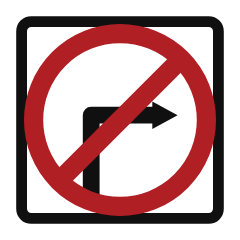
14. A driver's destination lies along the street to the right, and this sign stands at that corner. How should the driver reach it?
Show answer
Answer D: By going on and using a later intersection where turning is allowed
When a movement is barred at one corner the driver has to reroute, normally by continuing and coming back to the destination from a permitted approach.
-
15. A Nebraska license carries restriction code G. What does that restrict?
Show answer
Answer D: The holder may drive only during daylight hours
Nebraska's restriction code G limits the holder to daylight driving, separate from the Q code that bars interstate driving.
-
16. What should a rider do before riding an unfamiliar or borrowed motorcycle?
Show answer
Answer B: Locate and try the controls, then ride cautiously until used to the machine
Turn signals, horn, headlight switch, fuel valve and engine cut-off switch sit in different places on different models, and hunting for them in traffic is dangerous.
-
17. A snow squall cuts visibility to almost nothing while you are on a highway. What must you not do?
Show answer
Answer D: Stop in a travel lane and wait for the squall to blow through
A vehicle stopped in a lane in a whiteout is invisible until someone hits it. Slow gradually and keep moving until you can leave the roadway completely.
-
18. When may you stop on the shoulder of a freeway?
Show answer
Answer A: Only in an emergency, moving completely off the travel lanes and switching on your hazard lights
The freeway shoulder is reserved for emergencies and for disabled vehicles, and a vehicle stopped there must be clear of the travel lanes with hazard lights on.
-
19. Cones and drums mark a shifted lane through a work zone. What should you do?
Show answer
Answer A: Follow the path that they mark and stay inside it
Channelizing devices define the temporary travel path, and the space on the other side of them belongs to the workers.
-
20. Why does a passenger often feel the cold sooner than the rider on a long ride?
Show answer
Answer B: A passenger sits still and does not have the fuel tank to shelter behind
The rider has a screen or a tank to break the wind and is busy operating the machine, while a passenger sits exposed and inactive and chills faster.
-
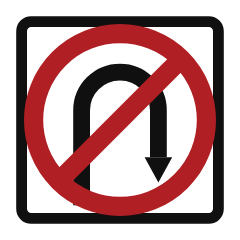
21. Why is this restriction used so often on a divided road just before a crest or a bend?
Show answer
Answer A: Because a vehicle turning across the median there stays hidden from approaching drivers until it is too late
The maneuver needs a long gap and good visibility, and where sight distance is short an approaching driver has no time to react to a vehicle turning across the road.
-
22. Where should a touring rider keep the rain suit?
Show answer
Answer B: Somewhere it can be reached quickly without unpacking everything
Rain gear only helps if you can get to it before you are soaked, so pack it where a quick roadside stop is enough to reach it.
-
23. After completing a turn you notice your signal is still flashing. What should you do?
Show answer
Answer A: Switch it off at once, before other drivers act on it
A signal left on after a turn is a false message, and drivers waiting to pull out may move into your path because of it.
-
24. Which of these fits Nebraska's definition of a moped?
Show answer
Answer D: A pedal-equipped bicycle with a motor of 50 cc or less and a 30 mph design speed
Nebraska defines a moped as a bicycle with fully operative pedals, an automatic transmission and a motor of no more than 50 cc producing no more than two brake horsepower at a design speed of 30 mph or less.
-
25. You are in the acceleration lane and the gap you were aiming for is now beside you. What is the best adjustment?
Show answer
Answer A: Change your speed a little to line up with a gap, then merge smoothly
The acceleration lane is for matching both the speed and the position of a gap, and small speed adjustments are what line the two up.