
Nebraska DMV Motorcycle Practice Test 3
Test 3 of 6. Pick an answer for each question to see if it is right and why; your score appears at the end. You need 20 correct answers to pass, the same ratio as the real Nebraska test.
- Questions25
- Correct to pass20
- Passing score80%
- Minimum age17 years
-
1. You are behind a slow vehicle on a two-lane road and a marked passing lane begins a mile ahead. What is the sensible choice?
Show answer
Answer D: Wait for the passing lane rather than using the opposing lane
A passing lane lets you overtake without ever entering the lane used by oncoming traffic, which is far safer than a pass a minute earlier.
-
2. Which of these alone can cost a Nebraska driver the license, even with a clean point total?
Show answer
Answer A: A conviction for no proof of insurance
Nebraska lists conviction of no proof of insurance among the grounds on which a license may be suspended, revoked or impounded, independently of the point system.
-
3. You are approaching a driveway where a car waits to pull out and the driver is looking your way. What should you assume?
Show answer
Answer D: The driver may not have seen you, so cover the brakes and be ready to slow
Looking in your direction is not proof that a driver has registered a motorcycle, so cover the brakes and be ready to slow until the car is clearly staying put.
-
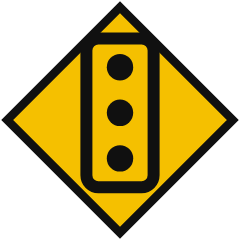
4. A driver passes this sign and the signal beyond it is already showing green. What is the safest response?
Show answer
Answer C: Ease off the accelerator and be ready to stop, because an indication that has been showing for a while is about to change
A signal that has been displaying the same indication for some time is close to changing, so arriving at a controlled speed with the brake covered is safer than accelerating to beat it.
-
5. A sign with a green background and a white legend normally provides
Show answer
Answer A: directions, distances and destinations
Green is the background color of the guide sign series, which names routes and destinations and gives the distance to them.
-
6. Why is a wet road at night harder to read than the same road in daylight?
Show answer
Answer A: The wet surface reflects light away and swallows the lane markings
A film of water sends your headlight beam onward instead of back to you, so lines, edges and people in dark clothing almost disappear.
-
7. Which two-wheelers may not lawfully be registered or operated on a Nebraska public roadway?
Show answer
Answer A: Those under 45 cubic centimeters, or with wheel and tire diameter under 14 inches
Nebraska bars registration or roadway operation of motorcycles, motor-bikes and motor scooters with engines under 45 cubic centimeters of displacement or a total wheel and tire diameter under 14 inches.
-
8. How many points does Nebraska assess for a conviction of driving under the influence of alcohol or drugs?
Show answer
Answer C: 6 points
A driving under the influence conviction carries six points on the Nebraska schedule, while a third offense carries twelve.
-
9. In Nebraska, how do the points differ when a failure to yield to a pedestrian causes bodily injury?
Show answer
Answer A: 4 points with injury and 2 points without
Failing to yield to a pedestrian is a two-point violation in Nebraska, and it rises to four points when the pedestrian is injured.
-
10. Which of these fits Nebraska's definition of a moped?
Show answer
Answer D: A pedal-equipped bicycle with a motor of 50 cc or less and a 30 mph design speed
Nebraska defines a moped as a bicycle with fully operative pedals, an automatic transmission and a motor of no more than 50 cc producing no more than two brake horsepower at a design speed of 30 mph or less.
-
11. What should you expect while driving through a parking lot?
Show answer
Answer D: Pedestrians and vehicles moving from any direction, so drive slowly
Parking lots mix walking people, reversing vehicles and poor sight lines, so low speed and constant scanning are the only reliable protection.
-
12. In Nebraska, how long do points from a traffic conviction keep counting toward a possible revocation?
Show answer
Answer A: Two years from the date of the violation
The conviction itself stays on a Nebraska record for five years, but the points stop counting two years after the violation date.
-
13. How closely may a Nebraska driver follow fire apparatus traveling in emergency status?
Show answer
Answer A: No closer than 500 feet
Nebraska forbids following fire apparatus in emergency status closer than five hundred feet, and also forbids parking within the block where it has stopped.
-
14. What fine range does Nebraska publish for texting while driving?
Show answer
Answer B: $200 to $500
The Nebraska driver's manual gives the fine for texting and driving as two hundred to five hundred dollars.
-
15. A large group has been divided into smaller groups. What should be done between them?
Show answer
Answer A: Leave a gap big enough for other vehicles to move in and pass safely
A gap between sub groups lets other traffic pass or merge without cutting into a formation, which keeps drivers from making sudden moves around the riders.
-
16. From what age may a Nebraska permit, license or State ID card holder record an organ and tissue donation decision at the DMV?
Show answer
Answer D: 16
Nebraska law lets holders aged 16 and over declare organ and tissue donation, although a parent or guardian may amend the decision of a donor under 18.
-
17. On traffic control devices, the color green shows direction to a destination and also shows
Show answer
Answer C: that a movement is permitted
Green carries two assignments: guidance toward destinations, and the idea that the movement shown is allowed, as on a green arrow.
-
18. How many points must a Nebraska driver collect within a two-year period before the license is automatically revoked?
Show answer
Answer D: 12 points
Accumulating 12 points in two years triggers an automatic six-month revocation of the Nebraska operator's license.
-
19. You are driving at night through heavy falling snow. Which headlight setting works better and why?
Show answer
Answer C: Low beams, because high beams bounce off the falling flakes back at you
Falling snow reflects light the way fog does, so high beams build a white wall of glare while low beams still give a usable view.
-
20. Which stopped vehicles displaying flashing lights does Nebraska's Move Over Law cover?
Show answer
Answer C: Emergency, road assistance, utility, highway maintenance and refuse collection vehicles
Nebraska's Move Over Law reaches stopped emergency, road assistance, public or private utility maintenance, highway maintenance, and solid waste or recycling collection vehicles with flashing lights.
-
21. The overhead signal above your lane changes to a steady yellow X. What should you do?
Show answer
Answer B: Prepare to move out of that lane
A steady yellow X warns that the lane is about to close, so drivers should get ready to vacate it in favor of an open lane.
-
22. Beyond the point this sign refers to, which movement becomes unlawful?

Show answer
Answer D: Driving on the far side of the separation, against the flow
Once the two directions are separated, each roadway carries one-way traffic, so crossing to the other side means driving into oncoming vehicles.
-
23. What does black ice usually look like from the driver seat?
Show answer
Answer C: A patch of pavement that simply looks wet or slightly glossy
Black ice is clear, so you see the dark road through it and read it as a wet patch. In freezing weather, treat any wet looking patch as ice.
-
24. How should the brake light be checked before a ride?
Show answer
Answer D: Confirm that the hand lever and the foot pedal each switch it on
Many motorcycles use a separate switch for each brake control, so both the lever and the pedal have to be tested one at a time.
-
25. Who is eligible for a Nebraska Sobriety Program Permit?
Show answer
Answer B: A 24/7 program participant, aged 18, who has held or tested for a Class O or Class M license
The Sobriety Program Permit is for 24/7 program participants with a court-certified order who are at least 18 and have held or tested for a Class O or Class M license, and it is not valid for commercial vehicles.